
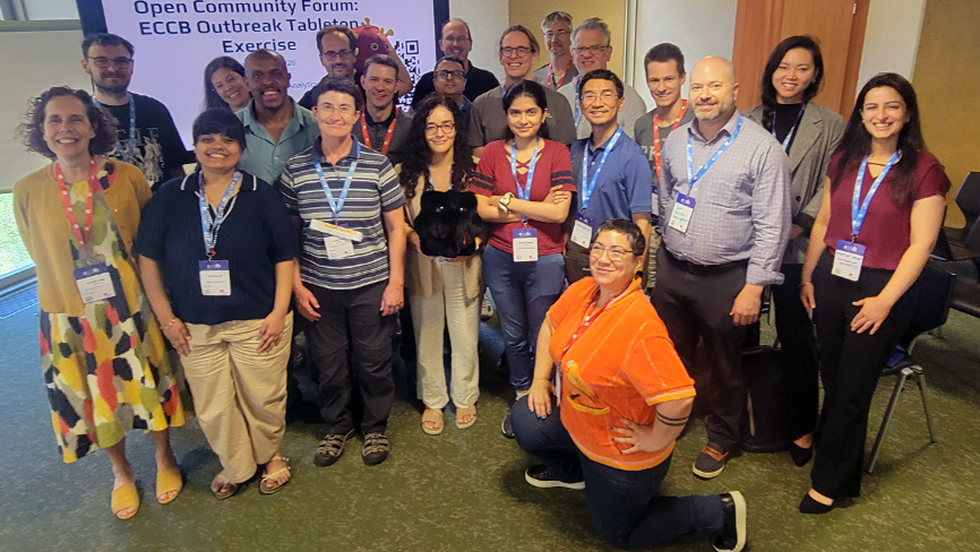
Data scientists, researchers, and health specialists identified opportunities for improving how data are shared and used during infectious disease outbreaks, during an Open Community Forum (OCF) co-hosted by PDN. The insights from US, Swiss and other international stakeholders – including representatives from PDN’s sister Bioinformatics Resource Centers (BRCs) – emerged from tabletop exercises on hypothetical outbreak scenarios. The latest of a series of community events to strengthen pathogen data infrastructure worldwide, the OCF took place alongside the 2026 European Conference on Computational Biology in Geneva.
Testing how pathogen data move during an outbreak
The event highlighted a rich global ecosystem of resources spanning the full lifecycle of pathogen data, from storage and discovery to genomic analyses and evolutionary biology. These include the ten resources coordinated by PDN, as well as infrastructure provided by the Bacterial and Viral Bioinformatics Resource Center (BV-BRC) and Bioinformatics Resource Analytics Center (BRC Analytics).
Participants considered two hypothetical outbreak scenarios: the detection of chikungunya virus in a mosquito population, and the detection of an unknown virus in one wastewater treatment plant. Both scenarios addressed a potential new threat rather than pathogens already monitored in national genomic surveillance programs.
Discussions centred on when and how data should be shared between data providers, clinicians and public health authorities as the outbreaks progressed. Factors considered by participants included:
- how to adapt existing genomic surveillance to a newly emerging threat, including through Switzerland’s Centre for Pathogen Bioinformatics and other national infrastructure;
- how data held by separate programmes can be rapidly compared, such as hospital case records and wastewater surveillance;
- routes for sharing unusual findings with international partners, alongside the formal channels already used by national authorities;
- how preliminary data should be managed while a finding is still uncertain.
Future events will build on the exercise with expanded stakeholder representation. The feedback will contribute to data-sharing practices that strengthen how PDN and other pathogen data resources serve their communities.
No single person or institution can solve the challenges of rapid and reliable pathogen data sharing alone. Real progress happens when we come together as a community – creating trusted spaces where practitioners can identify unresolved needs, share resources others may not have tried yet, and quickly connect with expertise across all steps of a workflow.
Fostering a global community for timely data sharing
The Open Community Forum was the fourth organized this year. The events form part of PDN’s work to promote knowledge exchange and harmonized practices for pathogen data and resources by connecting researchers, infrastructure developers, educators, public health officials and other stakeholders. To date they have collectively brought together over 80 participants from some 20 countries around the world.
Community events provide a necessary forum for pathogen data practitioners to share expertise and better coordinate pathogen data sharing – and confirm strong demand for continued exchange. The work of PDN and the other BRCs must be directly informed by the needs of stakeholders at all levels.
Two previous OCFs focused on the comprehensive resources provided by PDN, BV-BRC and BRC Analytics (5 June, Washington DC, USA, alongside the 2026 ASMicrobe conference) and new tools and approaches for analysing pathogen-related datasets (16 July, Washington DC, USA, alongside the 2026 annual conference of the International Society for Computational Biology).
A ‘community of practice’ OCF (25 June, Zurich, Switzerland) aimed to strengthen pathogen data infrastructure worldwide. Forty invited, international experts working at the interface of research and public health shared practical experience and insights on:
- reducing fragmentation and duplication on the global scale, drawing on PDN’s pathogen portal starter kit, Capacity Framework, and back-end Loculus and front-end Pathoplexus resources;
- scaling wastewater surveillance as a complement to clinical sampling, with technical demonstrations showing how PDN-linked resources (including V-pipe, GenSpectrum and IMMense) can support large-scale pathogen analysis and mutation tracking;
- how AI may reshape pathogen data workflows, from improving information discovery to supporting automated content generation – as long as analyses and underlying data are curated and validated.
Future planned community events will further support pathogen data sharing and analysis, advance emerging data applications, and expand an active global community of practice.