From the Ebola Bundibugyo to the Andes hantavirus, recent outbreaks are stark reminders of the continuing need for rapid access to reliable pathogen knowledge and genomic data. The Pathogen Data Network (PDN) brings together complementary resources that support every step of the scientific preparedness, from reliable biological knowledge and fast genomic sequence sharing, to data analysis and interpretation. The examples below show how this connected infrastructure was used in the context of the two outbreaks and can be rapidly adapted when new threats emerge.
Providing trusted biological knowledge on emerging threats
When a new threat is declared, researchers, public health authorities and healthcare professionals need to rely on trusted, curated biological knowledge to interpret emerging data.
In early May 2026, an outbreak of Andes virus, the only hantavirus known to spread between humans, struck the Hondius cruise ship, infecting 13 people and killing three. Days later, on 15 May, the DRC declared an Ebola outbreak caused by Bundibugyo virus, which spread to Uganda and was declared a Public Health Emergency of International Concern by WHO on 17 May.
As both outbreaks unfolded, PDN’s ViralZone, a reference knowledgebase on viruses, provided a range of dedicated information available to the scientific community within weeks of each outbreak, including dedicated factsheets on Ebolavirus and Andes virus.
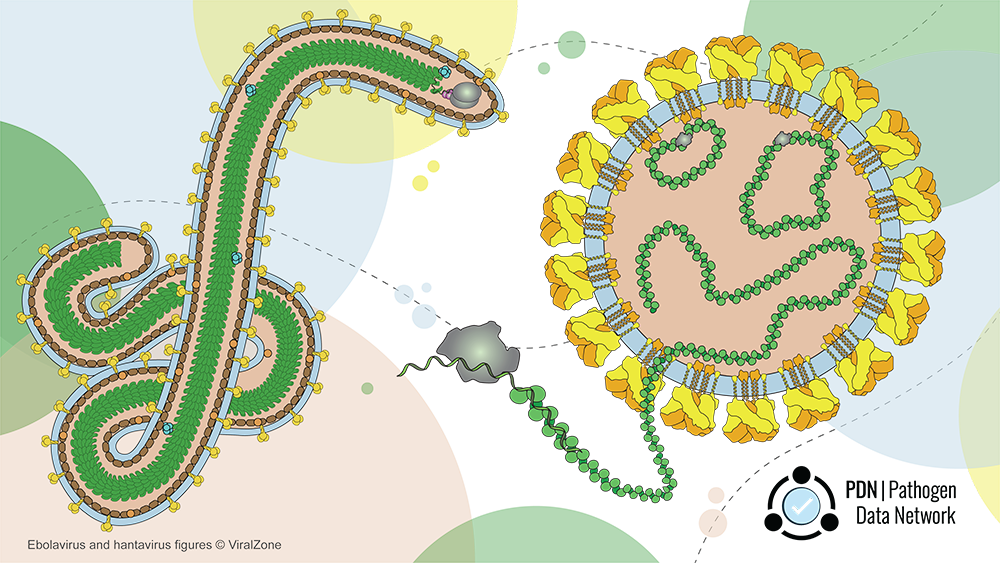
The dedicated pages gather essential biological information, from virus structure and genome organization to viral proteins, transmission, replication and genetic diversity. They also provide links to relevant data and analyses from the PDN ecosystem (incl. Nextstrain for evolutionary analysis and Pathoplexus for sequence data).
Making viral genomic data available quickly
Alongside reliable biological knowledge, outbreak response requires infrastructure through which genomic sequences and metadata can be stored, searched and accessed in near real-time. PDN’s Loculus provides scalable, open-source infrastructure for building and operating pathogen genomic databases.
Pathoplexus, a genomic data-sharing platform powered by Loculus, enabled teams in DRC and Uganda to share the first Ebola Bundibugyo virus genomes within days of the first cases being confirmed in May. By June, 15 genomes had been shared from DRC and one from Uganda. Five months on, the database holds over a thousand Bundibugyo sequences, with new genomes continuing to arrive as transmission persists in DRC. Those sequences have been reused by researchers outside the original sequencing teams, feeding into published analysis of how Ebola is evolving.
For Andes virus, Pathoplexus enabled teams from four countries to share outbreak-related sequences to the platform within days of the outbreak being identified, including the first complete genome sequence made publicly available, generated jointly by the Geneva Centre for Emerging Viral Diseases and the University of Zurich (Switzerland). The genome was similar to data available from prior outbreaks, reassuring public health agencies that the virus was not likely to be associated with increased severity or transmission despite the unusual circumstances of the outbreak.
This rapid turnaround helps ensure that researchers can start sharing, comparing and analyzing genomic data while an outbreak is still unfolding.
Connecting data with analysis
Once sequences are made available, researchers need to assess their quality, compare them with earlier data and understand how the virus is changing – which is something Nextstrain and Nextclade enable.
In particular for the Ebola Bundibugyo outbreak, Nextstrain makes it possible to compare sequences from 2026 with those from the 2007-2008 and 2012 outbreaks and examine their evolutionary relationships, while Nextclade provides complementary quality checks, making it easier to identify mutations, missing sequence regions and possible reading-frame disruptions before the genomes were used in further analyses.
These examples highlight just a few of the resources brought together through PDN where ViralZone provides reliable biological context, Loculus supplies adaptable infrastructure for managing and sharing genomic data, and Nextstrain and Nextclade help researchers assess and interpret the resulting sequences. By supporting and connecting these capabilities, PDN helps ensure researchers can respond fast as new threats emerge.
Explore the resources that make up PDN and how they work together to support pathogen research.
Watch the dedicated webinars
Both outbreaks were the focus of sessions in the NIAID Bioinformatics Resource Centers’ Tools for Tomorrow webinar series on infectious diseases:
- Andes virus webinar: Philippe Le Mercier (SIB Swiss Institute of Bioinformatics) presented the biology of Andes virus and how curated knowledge in ViralZone can help researchers work with newly generated data.
- Ebola Bundibugyo webinar: Philippe Le Mercier presented the biology of Bundibugyo virus in ViralZone, and Emma Hodcroft (SIB & Swiss Tropical and Public Health Institute) demonstrated how Nextstrain and Nextclade are used to analyze genomes from the outbreak.